Description
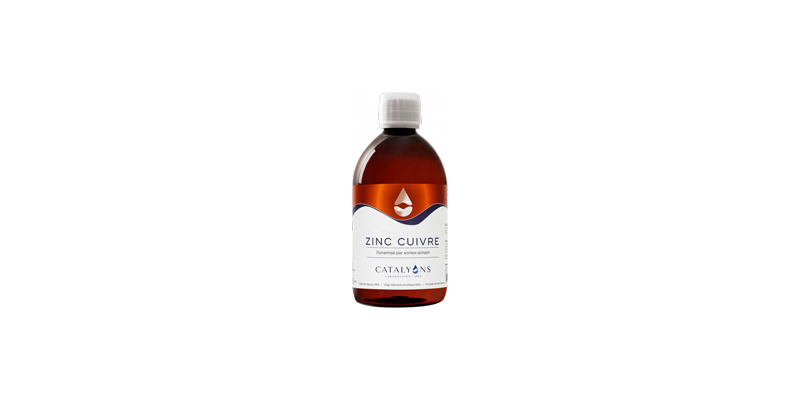
À propos de Zinc-cuivre Le Zinc-Cuivre de Catalyons est une association d'oligo-éléments naturels ioniques, obtenus par dissolution électro-catalytique des métaux dans l'eau purifiée. Cette forme ionique unique rend les Catalyons directement assimilables et prêts à l'emploi pour activer les enzymes. Ils sont dynamisés durant la fabrication par un procédé Vortex-Aimant. Propriétés uniques √ Forme ionique : les métaux sous forme d'ions "entourés" de molécules d'eau sont capables d'activer directement une enzyme √ Directement assimilables grâce à l'eau comme transporteur, contrairement aux oligo-éléments liés à des transporteurs chimiques ou sous formes solides √ Dynamisés pendant le processus de fabrication par un procédé Vortex-Aimant √ Catalyseurs intervenant dans les synthèses et régulations cellulaires nécessaires au maintien de la vie Allégations autorisées √ Le Zinc et le Cuivre contribuent au fonctionnement normal du système immunitaire √ Le Cuivre contribue au maintien de tissus conjonctifs normaux √ Le Zinc contribue au maintien d'une peau, d'ongles et de cheveux normaux
<style>.sc-desc{color:#3F524A;font-size:16px;line-height:1.65}.sc-desc__lead{max-width:72ch}.sc-desc__lead p{margin:0 0 14px}.sc-desc__lead p:first-child{font-size:18px;color:#14342B}.sc-desc__card{background:#fff;border:1px solid #E6EAE6;border-radius:14px;padding:22px 24px;margin-top:22px;box-shadow:0 1px 2px rgba(20,52,43,.04)}.sc-desc__card--claims{background:#F7FAF7;border-color:#DBE5DE}.sc-desc__h{margin:0 0 12px;font-size:17px;font-weight:700;color:#14342B;letter-spacing:-.01em}.sc-desc__p{margin:0 0 12px}.sc-desc__p:last-child{margin-bottom:0}.sc-desc__checks{list-style:none;margin:0;padding:0}.sc-desc__checks li{position:relative;padding:7px 0 7px 32px}.sc-desc__checks li::before{content:'';position:absolute;left:0;top:10px;width:20px;height:20px;border-radius:50%;background:#EDF2EE url("data:image/svg+xml,%3Csvg%20xmlns='http://www.w3.org/2000/svg'%20viewBox='0%200%2024%2024'%20fill='none'%20stroke='%231F6B4F'%20stroke-width='3.2'%20stroke-linecap='round'%20stroke-linejoin='round'%3E%3Cpath%20d='M5%2012.5l4.2%204L19%207'/%3E%3C/svg%3E") center/11px 11px no-repeat}.sc-desc__dots{margin:0;padding-left:20px}.sc-desc__dots li{padding:3px 0}.sc-desc__callout{display:flex;gap:14px;background:#EEF4F2;border:1px solid #D8E5E0;border-radius:12px;padding:18px 20px;margin-top:22px}.sc-desc__callout--care{background:#FBF6EC;border-color:#ECDDBE}.sc-desc__callout--care .sc-desc__h{color:#7E6418}.sc-desc__callout__icon{flex:0 0 auto;width:26px;height:26px;border-radius:50%;background:#1F6B4F;color:#fff;font-weight:700;font-size:15px;line-height:26px;text-align:center}.sc-desc__callout--care .sc-desc__callout__icon{background:#C99A2E}.sc-desc__callout .sc-desc__h{margin-bottom:8px}</style><div class="sc-desc"><div class="sc-desc__lead"><p>Le Zinc-Cuivre de Catalyons est une association d'oligo-éléments naturels ioniques, obtenus par dissolution électro-catalytique des métaux dans l'eau purifiée. Cette forme ionique unique rend les Catalyons directement assimilables et prêts à l'emploi pour activer les enzymes. Ils sont dynamisés durant la fabrication par un procédé Vortex-Aimant.</p></div><section class="sc-desc__card"><h3 class="sc-desc__h">Propriétés uniques</h3><ul class="sc-desc__checks"><li>Forme ionique: les métaux sous forme d'ions "entourés" de molécules d'eau sont capables d'activer directement une enzyme</li><li>Directement assimilables grâce à l'eau comme transporteur, contrairement aux oligo-éléments liés à des transporteurs chimiques ou sous formes solides</li><li>Dynamisés pendant le processus de fabrication par un procédé Vortex-Aimant</li><li>Catalyseurs intervenant dans les synthèses et régulations cellulaires nécessaires au maintien de la vie</li></ul></section><section class="sc-desc__card sc-desc__card--claims"><h3 class="sc-desc__h">Allégations autorisées</h3><ul class="sc-desc__checks"><li>Le Zinc et le Cuivre contribuent au fonctionnement normal du système immunitaire</li><li>Le Cuivre contribue au maintien de tissus conjonctifs normaux</li><li>Le Zinc contribue au maintien d'une peau, d'ongles et de cheveux normaux</li></ul></section></div>