Description
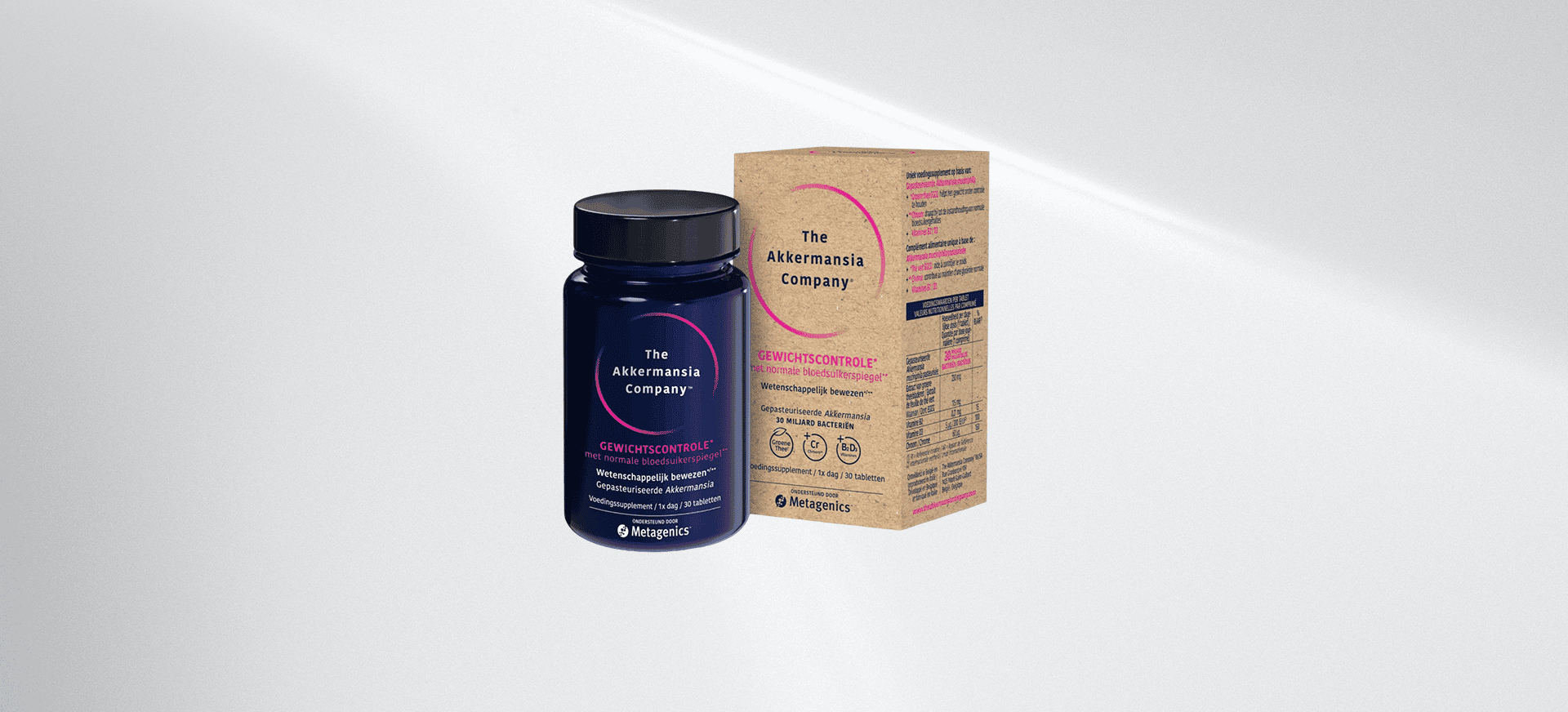
The next-generation postbiotic Supplement formulated with Akkermansia muciniphila , green tea leaf extract, chromium and vitamins B2 and D3. Akkermansia muciniphila is present in the human gut from early childhood. Its abundance then increases significantly into adulthood. Akkermansia muciniphila has even been detected in human breast milk. The bacterium's ability to use human milk oligosaccharides as a source of energy, carbon and nitrogen could explain its presence in the breast milk and mammary tissue of breastfeeding women. Human breast milk may act as a carrier of Akkermansia muciniphila and transfer the bacterium from mother to baby. This explains why the bacterium is already detected from a very young age in the gut of infants. Over the last ten years, a great deal of scientific data has come to “support the following hypothesis (tested collegially by Derrien, 2016): “the presence of A. muciniphila ” is associated with better health in humans.” Numerous studies have shown that the bacterium is positively associated with: √ A healthy intestinal mucosa √ A reduction in metabolic disorders √ A decrease in low-grade inflammation It is abundantly present in lean people without diabetes. It appears, however, to be less common in people suffering from various disorders such as obesity, diabetes, intestinal infections, liver disorders, or who make chronic use of alcohol. This is accompanied by a change in intestinal barrier function, which ultimately leads to low-grade inflammation and metabolic disorders. Indications √ For weight management with glucose control
<style>.sc-desc{color:#3F524A;font-size:16px;line-height:1.65}.sc-desc__lead{max-width:72ch}.sc-desc__lead p{margin:0 0 14px}.sc-desc__lead p:first-child{font-size:18px;color:#14342B}.sc-desc__card{background:#fff;border:1px solid #E6EAE6;border-radius:14px;padding:22px 24px;margin-top:22px;box-shadow:0 1px 2px rgba(20,52,43,.04)}.sc-desc__card--claims{background:#F7FAF7;border-color:#DBE5DE}.sc-desc__h{margin:0 0 12px;font-size:17px;font-weight:700;color:#14342B;letter-spacing:-.01em}.sc-desc__p{margin:0 0 12px}.sc-desc__p:last-child{margin-bottom:0}.sc-desc__checks{list-style:none;margin:0;padding:0}.sc-desc__checks li{position:relative;padding:7px 0 7px 32px}.sc-desc__checks li::before{content:'';position:absolute;left:0;top:10px;width:20px;height:20px;border-radius:50%;background:#EDF2EE url("data:image/svg+xml,%3Csvg%20xmlns='http://www.w3.org/2000/svg'%20viewBox='0%200%2024%2024'%20fill='none'%20stroke='%231F6B4F'%20stroke-width='3.2'%20stroke-linecap='round'%20stroke-linejoin='round'%3E%3Cpath%20d='M5%2012.5l4.2%204L19%207'/%3E%3C/svg%3E") center/11px 11px no-repeat}.sc-desc__dots{margin:0;padding-left:20px}.sc-desc__dots li{padding:3px 0}.sc-desc__callout{display:flex;gap:14px;background:#EEF4F2;border:1px solid #D8E5E0;border-radius:12px;padding:18px 20px;margin-top:22px}.sc-desc__callout--care{background:#FBF6EC;border-color:#ECDDBE}.sc-desc__callout--care .sc-desc__h{color:#7E6418}.sc-desc__callout__icon{flex:0 0 auto;width:26px;height:26px;border-radius:50%;background:#1F6B4F;color:#fff;font-weight:700;font-size:15px;line-height:26px;text-align:center}.sc-desc__callout--care .sc-desc__callout__icon{background:#C99A2E}.sc-desc__callout .sc-desc__h{margin-bottom:8px}</style><div class="sc-desc"><section class="sc-desc__card"><h3 class="sc-desc__h">The next-generation postbiotic</h3><p class="sc-desc__p">Supplement formulated with Akkermansia muciniphila, green tea leaf extract, chromium and vitamins B2 and D3.</p><p class="sc-desc__p">Akkermansia muciniphila is present in the human gut from early childhood. Its abundance then increases significantly into adulthood.</p><p class="sc-desc__p">Akkermansia muciniphila has even been detected in human breast milk. The bacterium's ability to use human milk oligosaccharides as a source of energy, carbon and nitrogen could explain its presence in the breast milk and mammary tissue of breastfeeding women. Human breast milk may act as a carrier of Akkermansia muciniphila and transfer the bacterium from mother to baby. This explains why the bacterium is already detected from a very young age in the gut of infants.</p><p class="sc-desc__p">Over the last ten years, a great deal of scientific data has come to “support the following hypothesis (tested collegially by Derrien, 2016): “the presence of A. muciniphila ” is associated with better health in humans.”</p><p class="sc-desc__p">Numerous studies have shown that the bacterium is positively associated with:</p><ul class="sc-desc__dots"><li>A healthy intestinal mucosa</li><li>A reduction in metabolic disorders</li><li>A decrease in low-grade inflammation</li></ul><p class="sc-desc__p">It is abundantly present in lean people without diabetes. It appears, however, to be less common in people suffering from various disorders such as obesity, diabetes, intestinal infections, liver disorders, or who make chronic use of alcohol. This is accompanied by a change in intestinal barrier function, which ultimately leads to low-grade inflammation and metabolic disorders.</p></section><section class="sc-desc__card"><h3 class="sc-desc__h">Indications</h3><ul class="sc-desc__dots"><li>For weight management with glucose control</li></ul></section></div>