Description
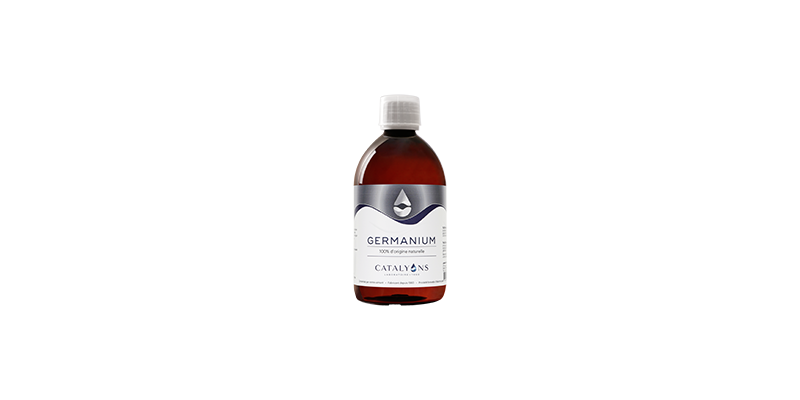
Germanium Germanium is a semiconductor element discovered in 1886 by a German chemist. Its name comes from Germany. The manufacture of Germanium through controlled electrolysis produces a high-quality, high-concentration Germanium solution. Trace element of natural origin. Catalyons are ionised natural trace elements . They are obtained through the electro-catalytic dissolution of metals in purified water, resulting in the formation of ions of these metals. This gives them a high degree of biological assimilation. Catalyons, being ions 'surrounded' by water molecules, are 'ready for use', since the metal in ionised form contributes to enzymatic activation . Catalyons offer several advantages: √ The ionic form : Catalyons, being ions "surrounded" by water molecules, are "ready to use" because the metal in ionic form is able to activate an enzyme. √ As water is the carrier of Catalyons, Catalyons are directly assimilable , unlike trace elements bound to chemical carriers or in solid forms. √ The energisation : Catalyon trace elements are energised during the manufacturing process using a Vortex-Magnet method. Catalyons are catalysts beyond dispute, personally involved in the various cellular syntheses and regulations necessary to sustain life.
<style>.sc-desc{color:#3F524A;font-size:16px;line-height:1.65}.sc-desc__lead{max-width:72ch}.sc-desc__lead p{margin:0 0 14px}.sc-desc__lead p:first-child{font-size:18px;color:#14342B}.sc-desc__card{background:#fff;border:1px solid #E6EAE6;border-radius:14px;padding:22px 24px;margin-top:22px;box-shadow:0 1px 2px rgba(20,52,43,.04)}.sc-desc__card--claims{background:#F7FAF7;border-color:#DBE5DE}.sc-desc__h{margin:0 0 12px;font-size:17px;font-weight:700;color:#14342B;letter-spacing:-.01em}.sc-desc__p{margin:0 0 12px}.sc-desc__p:last-child{margin-bottom:0}.sc-desc__checks{list-style:none;margin:0;padding:0}.sc-desc__checks li{position:relative;padding:7px 0 7px 32px}.sc-desc__checks li::before{content:'';position:absolute;left:0;top:10px;width:20px;height:20px;border-radius:50%;background:#EDF2EE url("data:image/svg+xml,%3Csvg%20xmlns='http://www.w3.org/2000/svg'%20viewBox='0%200%2024%2024'%20fill='none'%20stroke='%231F6B4F'%20stroke-width='3.2'%20stroke-linecap='round'%20stroke-linejoin='round'%3E%3Cpath%20d='M5%2012.5l4.2%204L19%207'/%3E%3C/svg%3E") center/11px 11px no-repeat}.sc-desc__dots{margin:0;padding-left:20px}.sc-desc__dots li{padding:3px 0}.sc-desc__callout{display:flex;gap:14px;background:#EEF4F2;border:1px solid #D8E5E0;border-radius:12px;padding:18px 20px;margin-top:22px}.sc-desc__callout--care{background:#FBF6EC;border-color:#ECDDBE}.sc-desc__callout--care .sc-desc__h{color:#7E6418}.sc-desc__callout__icon{flex:0 0 auto;width:26px;height:26px;border-radius:50%;background:#1F6B4F;color:#fff;font-weight:700;font-size:15px;line-height:26px;text-align:center}.sc-desc__callout--care .sc-desc__callout__icon{background:#C99A2E}.sc-desc__callout .sc-desc__h{margin-bottom:8px}</style><div class="sc-desc"><section class="sc-desc__card"><h3 class="sc-desc__h">Germanium</h3><p class="sc-desc__p">Germanium is a semiconductor element discovered in 1886 by a German chemist.</p><p class="sc-desc__p">Its name comes from Germany. The manufacture of Germanium through controlled electrolysis produces a high-quality, high-concentration Germanium solution.</p></section><section class="sc-desc__card"><h3 class="sc-desc__h">Trace element of natural origin.</h3><p class="sc-desc__p">Catalyons are ionised natural trace elements.</p><p class="sc-desc__p">They are obtained through the electro-catalytic dissolution of metals in purified water, resulting in the formation of ions of these metals. This gives them a high degree of biological assimilation. Catalyons, being ions 'surrounded' by water molecules, are 'ready for use', since the metal in ionised form contributes to enzymatic activation.</p><p class="sc-desc__p">Catalyons offer several advantages:</p><ul class="sc-desc__dots"><li>The ionic form: Catalyons, being ions "surrounded" by water molecules, are "ready to use" because the metal in ionic form is able to activate an enzyme.</li><li>As water is the carrier of Catalyons, Catalyons are directly assimilable, unlike trace elements bound to chemical carriers or in solid forms.</li><li>The energisation: Catalyon trace elements are energised during the manufacturing process using a Vortex-Magnet method.</li></ul><p class="sc-desc__p">Catalyons are catalysts beyond dispute, personally involved in the various cellular syntheses and regulations necessary to sustain life.</p></section></div>