Description
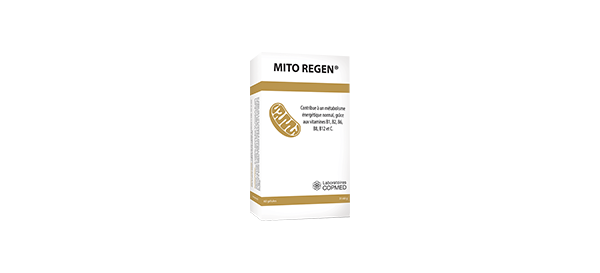
Mito Regen® is a supplement for the mitochondria. HOW DOES MITO REGEN® WORK? ✓ Activates mitophagy and the synthesis of new mitochondria. ✓ Protects against oxidative stress. ✓ Optimises energy production by the mitochondria. WHICH ACTIVE INGREDIENTS MAKE UP MITO REGEN®? This is a unique synergy of vitamins (B, C and E), minerals (selenium, zinc, manganese), N-acetylcysteine, PQQ, R-alpha-lipoic acid, L-carnitine, and two patented actives: Ubiquinol – Kaneka Ubiquinol™ and L-ergothioneine – Ergoneine® Tetrahedron. Ubiquinol is the biologically active form of coenzyme Q10 (CoQ10), whose absorption is greatly increased compared with the oxidised form, ubiquinone. CoQ10 is the major mitochondrial cofactor. It is what transports electrons between the complexes of the respiratory chain. Supplementing with the latter therefore increases ATP synthesis. PQQ is a cofactor used by certain oxidoreductase enzymes, influencing a multitude of biological processes. It leads to more efficient energy production through its action on mitochondrial biosynthesis and also through raising NAD+ levels (a coenzyme involved in the 4 stages of cellular respiration). Around 1,000 studies attest to the functions of PQQ. It has been proven that it is strongly involved in mitochondrial biogenesis. It has been shown that a deficiency in PQQ would lead to a 20 to 30% reduction in the relative quantity of mitochondria in the liver. L-ergothioneine is a derivative of an amino acid essential for protein formation, histidine. L-ergothioneine increases cellular respiration and energy metabolism through fat oxidation. It is able to create NAD+ from NADH and thus increases intracellular ATP levels. L-ergothioneine is said to have the ability to promote the mitophagy mechanism of mitochondria, that is, the destruction of tired or dysfunctional mitochondria. Indeed, L-ergothioneine is an activator of NRF2, a factor promoting mitophagy. It is also said to contribute to the transport of worn-out mitochondria out of the cell to make way for healthy mitochondria. Manganese is a cofactor of an enzyme involved in the Krebs cycle. It is therefore necessary for energy production by the mitochondria. Vitamins C, B1, B2, B3, B6, B8 and B12 contribute to normal energy metabolism. Vitamins C, B2, B3, B6 and B12 contribute to reducing fatigue. Vitamins C, B2, E, selenium and zinc contribute to protecting cells against oxidative stress. Vitamins C, B1, B3, B6, B8 and B12 contribute to the normal functioning of the nervous system and to normal psychological function. Vitamin B2 also contributes to the normal functioning of the nervous system. Zinc contributes to normal cognitive function, normal macronutrient and fatty-acid metabolism, and normal protein synthesis. N-acetylcysteine, R-alpha-lipoic acid and L-carnitine have demonstrated their antioxidant power.
<style>.sc-desc{color:#3F524A;font-size:16px;line-height:1.65}.sc-desc__lead{max-width:72ch}.sc-desc__lead p{margin:0 0 14px}.sc-desc__lead p:first-child{font-size:18px;color:#14342B}.sc-desc__card{background:#fff;border:1px solid #E6EAE6;border-radius:14px;padding:22px 24px;margin-top:22px;box-shadow:0 1px 2px rgba(20,52,43,.04)}.sc-desc__card--claims{background:#F7FAF7;border-color:#DBE5DE}.sc-desc__h{margin:0 0 12px;font-size:17px;font-weight:700;color:#14342B;letter-spacing:-.01em}.sc-desc__p{margin:0 0 12px}.sc-desc__p:last-child{margin-bottom:0}.sc-desc__checks{list-style:none;margin:0;padding:0}.sc-desc__checks li{position:relative;padding:7px 0 7px 32px}.sc-desc__checks li::before{content:'';position:absolute;left:0;top:10px;width:20px;height:20px;border-radius:50%;background:#EDF2EE url("data:image/svg+xml,%3Csvg%20xmlns='http://www.w3.org/2000/svg'%20viewBox='0%200%2024%2024'%20fill='none'%20stroke='%231F6B4F'%20stroke-width='3.2'%20stroke-linecap='round'%20stroke-linejoin='round'%3E%3Cpath%20d='M5%2012.5l4.2%204L19%207'/%3E%3C/svg%3E") center/11px 11px no-repeat}.sc-desc__dots{margin:0;padding-left:20px}.sc-desc__dots li{padding:3px 0}.sc-desc__callout{display:flex;gap:14px;background:#EEF4F2;border:1px solid #D8E5E0;border-radius:12px;padding:18px 20px;margin-top:22px}.sc-desc__callout--care{background:#FBF6EC;border-color:#ECDDBE}.sc-desc__callout--care .sc-desc__h{color:#7E6418}.sc-desc__callout__icon{flex:0 0 auto;width:26px;height:26px;border-radius:50%;background:#1F6B4F;color:#fff;font-weight:700;font-size:15px;line-height:26px;text-align:center}.sc-desc__callout--care .sc-desc__callout__icon{background:#C99A2E}.sc-desc__callout .sc-desc__h{margin-bottom:8px}</style><div class="sc-desc"><div class="sc-desc__lead"><p>Mito Regen® is a supplement for the mitochondria.</p></div><section class="sc-desc__card"><h3 class="sc-desc__h">HOW DOES MITO REGEN® WORK?</h3><ul class="sc-desc__dots"><li>Activates mitophagy and the synthesis of new mitochondria.</li><li>Protects against oxidative stress.</li><li>Optimises energy production by the mitochondria.</li></ul></section><section class="sc-desc__card"><h3 class="sc-desc__h">WHICH ACTIVE INGREDIENTS MAKE UP MITO REGEN®?</h3><p class="sc-desc__p">This is a unique synergy of vitamins (B, C and E), minerals (selenium, zinc, manganese), N-acetylcysteine, PQQ, R-alpha-lipoic acid, L-carnitine, and two patented actives: Ubiquinol – Kaneka Ubiquinol™ and L-ergothioneine – Ergoneine® Tetrahedron.</p><p class="sc-desc__p">Ubiquinol is the biologically active form of coenzyme Q10 (CoQ10), whose absorption is greatly increased compared with the oxidised form, ubiquinone. CoQ10 is the major mitochondrial cofactor. It is what transports electrons between the complexes of the respiratory chain. Supplementing with the latter therefore increases ATP synthesis.</p><p class="sc-desc__p">PQQ is a cofactor used by certain oxidoreductase enzymes, influencing a multitude of biological processes. It leads to more efficient energy production through its action on mitochondrial biosynthesis and also through raising NAD+ levels (a coenzyme involved in the 4 stages of cellular respiration). Around 1,000 studies attest to the functions of PQQ. It has been proven that it is strongly involved in mitochondrial biogenesis. It has been shown that a deficiency in PQQ would lead to a 20 to 30% reduction in the relative quantity of mitochondria in the liver.</p><p class="sc-desc__p">L-ergothioneine is a derivative of an amino acid essential for protein formation, histidine. L-ergothioneine increases cellular respiration and energy metabolism through fat oxidation. It is able to create NAD+ from NADH and thus increases intracellular ATP levels. L-ergothioneine is said to have the ability to promote the mitophagy mechanism of mitochondria, that is, the destruction of tired or dysfunctional mitochondria. Indeed, L-ergothioneine is an activator of NRF2, a factor promoting mitophagy. It is also said to contribute to the transport of worn-out mitochondria out of the cell to make way for healthy mitochondria.</p><p class="sc-desc__p">Manganese is a cofactor of an enzyme involved in the Krebs cycle. It is therefore necessary for energy production by the mitochondria.</p><p class="sc-desc__p">Vitamins C, B1, B2, B3, B6, B8 and B12 contribute to normal energy metabolism.</p><p class="sc-desc__p">Vitamins C, B2, B3, B6 and B12 contribute to reducing fatigue.</p><p class="sc-desc__p">Vitamins C, B2, E, selenium and zinc contribute to protecting cells against oxidative stress.</p><p class="sc-desc__p">Vitamins C, B1, B3, B6, B8 and B12 contribute to the normal functioning of the nervous system and to normal psychological function.</p><p class="sc-desc__p">Vitamin B2 also contributes to the normal functioning of the nervous system.</p><p class="sc-desc__p">Zinc contributes to normal cognitive function, normal macronutrient and fatty-acid metabolism, and normal protein synthesis.</p><p class="sc-desc__p">N-acetylcysteine, R-alpha-lipoic acid and L-carnitine have demonstrated their antioxidant power.</p></section></div>