Description
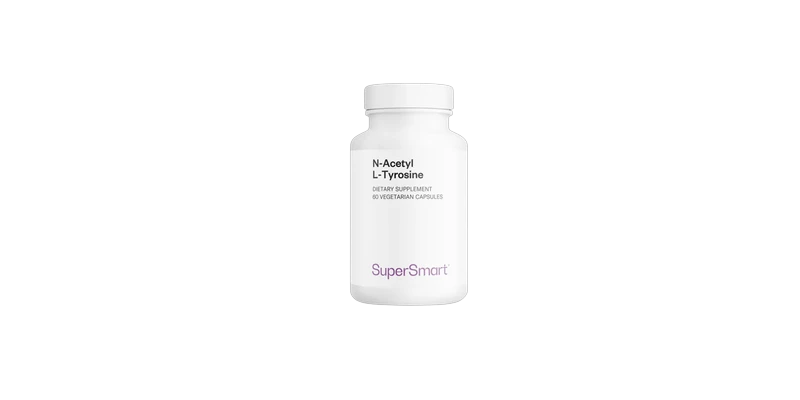
N-Acetyl L-Tyrosine is a supplement containing tyrosine , a proteinogenic amino acid produced by the body from phenylalanine. It plays a role in the production of melanin, the pigment responsible for skin colour, and in mood regulation . Tyrosine dose: how much should be taken per day? Tyrosine is produced by the body from phenylalanine, whose dietary requirements have been assessed by the WHO at 1.5 to 2 g (1-2). However, when metabolic demand exceeds what can be produced endogenously , tyrosine must be obtained in sufficient quantity from the diet, as is the case for other amino acids such as taurine, glycine, arginine and proline. In these relatively common cases (fatigue, overtraining, depression), tyrosine supplements can be useful. Indeed, tyrosine is involved in the synthesis of catecholamines – adrenaline, noradrenaline and DOPA – as well as melanin and thyroid hormones. What happens to tyrosine in the body once it is ingested? Tyrosine is able to cross the blood-brain barrier and reach the brain, where a fraction of it is converted by the action of an enzyme called tyrosine-hydroxylase (4), which is in turn converted into the hormone known as the “pleasure” hormone. Studies show that these conversions increase in situations of stress or intense cognitive exertion (5-7). In the medium term, however, stress is known to reduce the level and performance of catecholamines, probably due to the fact that the amino acids that contribute to their production become depleted.
<style>.sc-desc{color:#3F524A;font-size:16px;line-height:1.65}.sc-desc__lead{max-width:72ch}.sc-desc__lead p{margin:0 0 14px}.sc-desc__lead p:first-child{font-size:18px;color:#14342B}.sc-desc__card{background:#fff;border:1px solid #E6EAE6;border-radius:14px;padding:22px 24px;margin-top:22px;box-shadow:0 1px 2px rgba(20,52,43,.04)}.sc-desc__card--claims{background:#F7FAF7;border-color:#DBE5DE}.sc-desc__h{margin:0 0 12px;font-size:17px;font-weight:700;color:#14342B;letter-spacing:-.01em}.sc-desc__p{margin:0 0 12px}.sc-desc__p:last-child{margin-bottom:0}.sc-desc__checks{list-style:none;margin:0;padding:0}.sc-desc__checks li{position:relative;padding:7px 0 7px 32px}.sc-desc__checks li::before{content:'';position:absolute;left:0;top:10px;width:20px;height:20px;border-radius:50%;background:#EDF2EE url("data:image/svg+xml,%3Csvg%20xmlns='http://www.w3.org/2000/svg'%20viewBox='0%200%2024%2024'%20fill='none'%20stroke='%231F6B4F'%20stroke-width='3.2'%20stroke-linecap='round'%20stroke-linejoin='round'%3E%3Cpath%20d='M5%2012.5l4.2%204L19%207'/%3E%3C/svg%3E") center/11px 11px no-repeat}.sc-desc__dots{margin:0;padding-left:20px}.sc-desc__dots li{padding:3px 0}.sc-desc__callout{display:flex;gap:14px;background:#EEF4F2;border:1px solid #D8E5E0;border-radius:12px;padding:18px 20px;margin-top:22px}.sc-desc__callout--care{background:#FBF6EC;border-color:#ECDDBE}.sc-desc__callout--care .sc-desc__h{color:#7E6418}.sc-desc__callout__icon{flex:0 0 auto;width:26px;height:26px;border-radius:50%;background:#1F6B4F;color:#fff;font-weight:700;font-size:15px;line-height:26px;text-align:center}.sc-desc__callout--care .sc-desc__callout__icon{background:#C99A2E}.sc-desc__callout .sc-desc__h{margin-bottom:8px}</style><div class="sc-desc"><div class="sc-desc__lead"><p>N-Acetyl L-Tyrosine is a supplement containing tyrosine, a proteinogenic amino acid produced by the body from phenylalanine.</p><p>It plays a role in the production of melanin, the pigment responsible for skin colour, and in mood regulation.</p></div><section class="sc-desc__card"><h3 class="sc-desc__h">Tyrosine dose: how much should be taken per day?</h3><p class="sc-desc__p">Tyrosine is produced by the body from phenylalanine, whose dietary requirements have been assessed by the WHO at 1.5 to 2 g (1-2). However, when metabolic demand exceeds what can be produced endogenously, tyrosine must be obtained in sufficient quantity from the diet, as is the case for other amino acids such as taurine, glycine, arginine and proline.</p><p class="sc-desc__p">In these relatively common cases (fatigue, overtraining, depression), tyrosine supplements can be useful. Indeed, tyrosine is involved in the synthesis of catecholamines – adrenaline, noradrenaline and DOPA – as well as melanin and thyroid hormones.</p></section><section class="sc-desc__card"><h3 class="sc-desc__h">What happens to tyrosine in the body once it is ingested?</h3><p class="sc-desc__p">Tyrosine is able to cross the blood-brain barrier and reach the brain, where a fraction of it is converted by the action of an enzyme called tyrosine-hydroxylase (4), which is in turn converted into the hormone known as the “pleasure” hormone. Studies show that these conversions increase in situations of stress or intense cognitive exertion (5-7). In the medium term, however, stress is known to reduce the level and performance of catecholamines, probably due to the fact that the amino acids that contribute to their production become depleted.</p></section></div>