Description
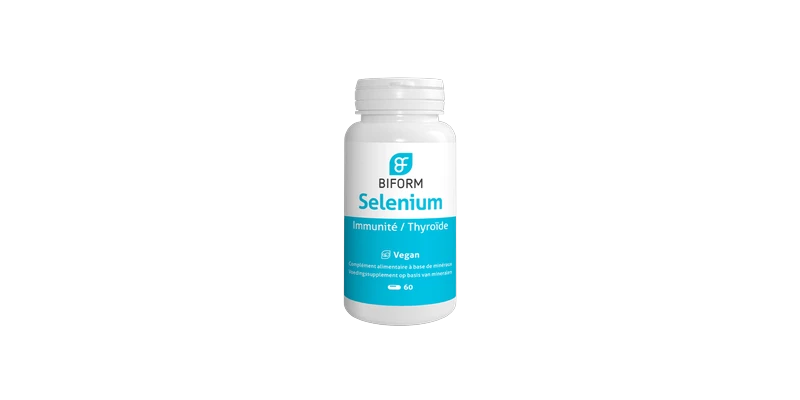
About Selenium Selenium is an antioxidant trace element playing a key role in several of the body's protective functions, particularly in the fight against oxidative stress. It is mainly stored in the muscles and liver. At the intracellular level, it enables the production of glutathione peroxidase, an enzyme that acts in synergy with vitamin E to protect cell membranes. Selenium contributes: √ to stimulate the immune system √ to the synthesis and metabolism of thyroid hormones √ to strengthening the antioxidant defence system Did you know? The selenium content of food depends on the soil in which it is grown. Brazil nuts are particularly rich in selenium, providing the entire recommended daily intake on their own.
<style>.sc-desc{color:#3F524A;font-size:16px;line-height:1.65}.sc-desc__lead{max-width:72ch}.sc-desc__lead p{margin:0 0 14px}.sc-desc__lead p:first-child{font-size:18px;color:#14342B}.sc-desc__card{background:#fff;border:1px solid #E6EAE6;border-radius:14px;padding:22px 24px;margin-top:22px;box-shadow:0 1px 2px rgba(20,52,43,.04)}.sc-desc__card--claims{background:#F7FAF7;border-color:#DBE5DE}.sc-desc__h{margin:0 0 12px;font-size:17px;font-weight:700;color:#14342B;letter-spacing:-.01em}.sc-desc__p{margin:0 0 12px}.sc-desc__p:last-child{margin-bottom:0}.sc-desc__checks{list-style:none;margin:0;padding:0}.sc-desc__checks li{position:relative;padding:7px 0 7px 32px}.sc-desc__checks li::before{content:'';position:absolute;left:0;top:10px;width:20px;height:20px;border-radius:50%;background:#EDF2EE url("data:image/svg+xml,%3Csvg%20xmlns='http://www.w3.org/2000/svg'%20viewBox='0%200%2024%2024'%20fill='none'%20stroke='%231F6B4F'%20stroke-width='3.2'%20stroke-linecap='round'%20stroke-linejoin='round'%3E%3Cpath%20d='M5%2012.5l4.2%204L19%207'/%3E%3C/svg%3E") center/11px 11px no-repeat}.sc-desc__dots{margin:0;padding-left:20px}.sc-desc__dots li{padding:3px 0}.sc-desc__callout{display:flex;gap:14px;background:#EEF4F2;border:1px solid #D8E5E0;border-radius:12px;padding:18px 20px;margin-top:22px}.sc-desc__callout--care{background:#FBF6EC;border-color:#ECDDBE}.sc-desc__callout--care .sc-desc__h{color:#7E6418}.sc-desc__callout__icon{flex:0 0 auto;width:26px;height:26px;border-radius:50%;background:#1F6B4F;color:#fff;font-weight:700;font-size:15px;line-height:26px;text-align:center}.sc-desc__callout--care .sc-desc__callout__icon{background:#C99A2E}.sc-desc__callout .sc-desc__h{margin-bottom:8px}</style><div class="sc-desc"><div class="sc-desc__lead"><p>Selenium is an antioxidant trace element playing a key role in several of the body's protective functions, particularly in the fight against oxidative stress. It is mainly stored in the muscles and liver.</p><p>At the intracellular level, it enables the production of glutathione peroxidase, an enzyme that acts in synergy with vitamin E to protect cell membranes.</p><p>Selenium contributes:</p></div><section class="sc-desc__card"><ul class="sc-desc__checks"><li>to stimulate the immune system</li><li>to the synthesis and metabolism of thyroid hormones</li><li>to strengthening the antioxidant defence system</li></ul></section><section class="sc-desc__card"><h3 class="sc-desc__h">Did you know?</h3><p class="sc-desc__p">The selenium content of food depends on the soil in which it is grown. Brazil nuts are particularly rich in selenium, providing the entire recommended daily intake on their own.</p></section></div>