Description
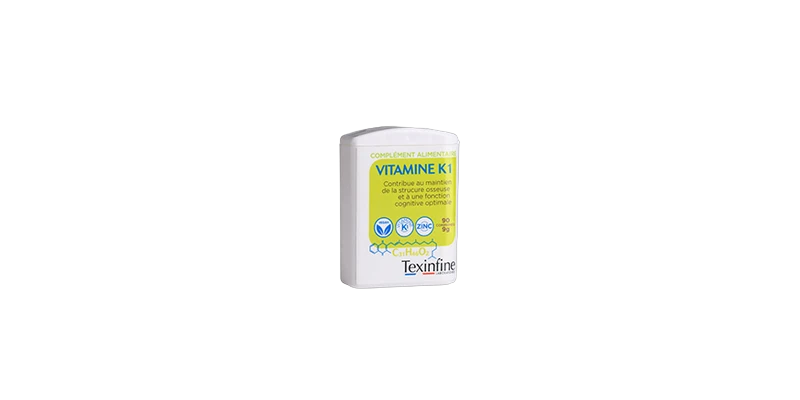
Description The vitamin K is important for bone health. It supports the action of a protein hormone that is part of the bone structure : osteocalcin. The vitamin K is also essential for blood clotting and takes part in communication between nerve cells. Known as the vitamin of intelligence, the vitamin K contributes to maintaining optimal cognitive function, supporting the capacities of our brain that allow us to interact with our environment (concentration, perception, reasoning, memory...). WHO IS VITAMIN K1 FOR ? Generally speaking, vitamin K1 supplementation is indicated for people with vitamin K deficiencies and is recommended as a preventive measure to avoid such a deficiency. √ As support against bone calcification. √ For older people wishing to improve their cognitive functions (memory, communication...). √ For students wishing to optimise their concentration. √ Blood clotting problems. √ People undergoing treatment that may cause haemorrhage (powerful antibiotics, anticoagulants, medications preventing absorption of vitamin K). √ Certain women before childbirth. √ Liver and gallbladder problems. √ Problems limiting the absorption of vitamin K.
<style>.sc-desc{color:#3F524A;font-size:16px;line-height:1.65}.sc-desc__lead{max-width:72ch}.sc-desc__lead p{margin:0 0 14px}.sc-desc__lead p:first-child{font-size:18px;color:#14342B}.sc-desc__card{background:#fff;border:1px solid #E6EAE6;border-radius:14px;padding:22px 24px;margin-top:22px;box-shadow:0 1px 2px rgba(20,52,43,.04)}.sc-desc__card--claims{background:#F7FAF7;border-color:#DBE5DE}.sc-desc__h{margin:0 0 12px;font-size:17px;font-weight:700;color:#14342B;letter-spacing:-.01em}.sc-desc__p{margin:0 0 12px}.sc-desc__p:last-child{margin-bottom:0}.sc-desc__checks{list-style:none;margin:0;padding:0}.sc-desc__checks li{position:relative;padding:7px 0 7px 32px}.sc-desc__checks li::before{content:'';position:absolute;left:0;top:10px;width:20px;height:20px;border-radius:50%;background:#EDF2EE url("data:image/svg+xml,%3Csvg%20xmlns='http://www.w3.org/2000/svg'%20viewBox='0%200%2024%2024'%20fill='none'%20stroke='%231F6B4F'%20stroke-width='3.2'%20stroke-linecap='round'%20stroke-linejoin='round'%3E%3Cpath%20d='M5%2012.5l4.2%204L19%207'/%3E%3C/svg%3E") center/11px 11px no-repeat}.sc-desc__dots{margin:0;padding-left:20px}.sc-desc__dots li{padding:3px 0}.sc-desc__callout{display:flex;gap:14px;background:#EEF4F2;border:1px solid #D8E5E0;border-radius:12px;padding:18px 20px;margin-top:22px}.sc-desc__callout--care{background:#FBF6EC;border-color:#ECDDBE}.sc-desc__callout--care .sc-desc__h{color:#7E6418}.sc-desc__callout__icon{flex:0 0 auto;width:26px;height:26px;border-radius:50%;background:#1F6B4F;color:#fff;font-weight:700;font-size:15px;line-height:26px;text-align:center}.sc-desc__callout--care .sc-desc__callout__icon{background:#C99A2E}.sc-desc__callout .sc-desc__h{margin-bottom:8px}</style><div class="sc-desc"><section class="sc-desc__card"><h3 class="sc-desc__h">Description</h3><p class="sc-desc__p">The vitamin K is important for bone health. It supports the action of a protein hormone that is part of the bone structure : osteocalcin.</p><p class="sc-desc__p">The vitamin K is also essential for blood clotting and takes part in communication between nerve cells. Known as the vitamin of intelligence, the vitamin K contributes to maintaining optimal cognitive function, supporting the capacities of our brain that allow us to interact with our environment (concentration, perception, reasoning, memory...).</p></section><section class="sc-desc__card"><h3 class="sc-desc__h">WHO IS VITAMIN K1 FOR ?</h3><p class="sc-desc__p">Generally speaking, vitamin K1 supplementation is indicated for people with vitamin K deficiencies and is recommended as a preventive measure to avoid such a deficiency.</p><ul class="sc-desc__dots"><li>As support against bone calcification.</li><li>For older people wishing to improve their cognitive functions (memory, communication...).</li><li>For students wishing to optimise their concentration.</li><li>Blood clotting problems.</li><li>People undergoing treatment that may cause haemorrhage (powerful antibiotics, anticoagulants, medications preventing absorption of vitamin K).</li><li>Certain women before childbirth.</li><li>Liver and gallbladder problems.</li><li>Problems limiting the absorption of vitamin K.</li></ul></section></div>