Description
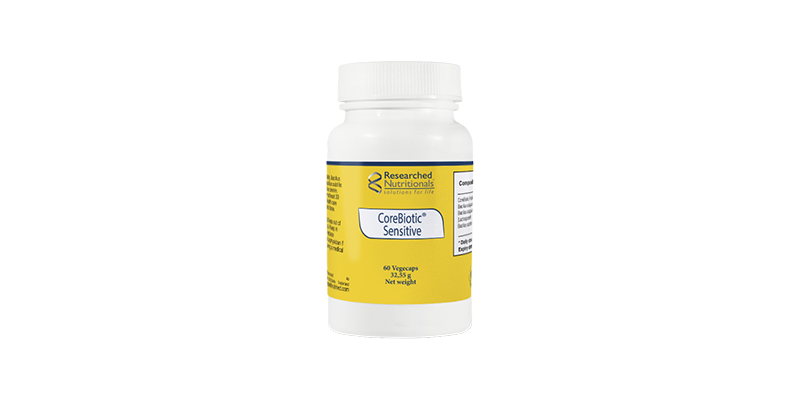
CoreBiotic® CoreBiotic® Sensitive was specially developed for patients trying to avoid fibre and is an ideal probiotic for patients following a low-FODMAP diet. CoreBiotic® Sensitive contains the same 11 billion CFU per dose and the same research-based strains as CoreBiotic®, but without the VitaFiber™ prebiotic. CoreBiotic® Sensitive - the same powerful formulation as CoreBiotic®, without added prebiotic. For those who prefer to have the prebiotic, please see Corebiotic®. CoreBiotic® Sensitive combines three fully sequenced and registered spore-based probiotics to support a healthy microbiome. Each strain was specifically chosen for its mechanisms of action, supported by supporting research. Key features √ Prebiotic-free, for sensitive patients √ Vegan, dairy-free, gluten-free and non-GMO √ 11 billion CFU per dose √ No refrigeration required Spore-based probiotics are derived from the soil and are sometimes called soil-based organisms, or SBOs. Traditionally, when people consumed minimally processed soil products, they inadvertently ingested these probiotics present in the soil. These SBOs were crucial for maintaining a normal gut microbiome. Due to modern farming techniques, particularly excessive processing and the use of pesticides and herbicides, people no longer naturally consume these beneficial SBO bacteria as they traditionally did. Benefits of spore-based probiotics Sporulated strains present several advantages compared with their live counterparts. In particular, their ability to form a protective spore. This spore allows them to withstand much harsher environments such as those present in the stomach, allowing them to reach the intestines where their benefits can be fully exploited. This also means they do not require refrigeration. Randomised, double-blind, placebo-controlled trials have established the safety of SBOs for humans, and their efficacy has been demonstrated in dozens of published, peer-reviewed studies. Once in the intestines, SBOs leave their spore form and act in the same way as any probiotic. Competitive inhibition helps beneficial probiotic bacteria proliferate and crowd out harmful bacteria. Each CoreBiotic® Sensitive strain is identified by genomic sequencing for greater specificity, so that you know you are getting the same product every time. Only strain-specific probiotics have been the subject of rigorous genomic studies, guaranteeing precise strain specificity, potency and safety. Features Constituents/Actions Benefits Bacillus subtilis probiotic complex (DE111 strain) √ Research showing an increase in beneficial Bifidobacterium √ Supports normal immune response of intestinal cells √ Communicates with intestinal cells to maintain a healthy intestinal barrier function √ Works by competitive exclusion (to the detriment of harmful bacteria) √ Isolated and described in 1915. √ It is considered a normal inhabitant of the gut in animals and humans. Bacillus Coagulans (SNZ1969) √ Survives the gastric acid barrier and produces L+ lactic acid, which is beneficial for the gut. √ Safely used as a probiotic for over 45 years Bacillus coagulans (Lactospore strain MTCC 5856) √ Works by competitive exclusion (to the detriment of harmful bacteria) √ Helps regulate gastrointestinal motility
<style>.sc-desc{color:#3F524A;font-size:16px;line-height:1.65}.sc-desc__lead{max-width:72ch}.sc-desc__lead p{margin:0 0 14px}.sc-desc__lead p:first-child{font-size:18px;color:#14342B}.sc-desc__card{background:#fff;border:1px solid #E6EAE6;border-radius:14px;padding:22px 24px;margin-top:22px;box-shadow:0 1px 2px rgba(20,52,43,.04)}.sc-desc__card--claims{background:#F7FAF7;border-color:#DBE5DE}.sc-desc__h{margin:0 0 12px;font-size:17px;font-weight:700;color:#14342B;letter-spacing:-.01em}.sc-desc__p{margin:0 0 12px}.sc-desc__p:last-child{margin-bottom:0}.sc-desc__checks{list-style:none;margin:0;padding:0}.sc-desc__checks li{position:relative;padding:7px 0 7px 32px}.sc-desc__checks li::before{content:'';position:absolute;left:0;top:10px;width:20px;height:20px;border-radius:50%;background:#EDF2EE url("data:image/svg+xml,%3Csvg%20xmlns='http://www.w3.org/2000/svg'%20viewBox='0%200%2024%2024'%20fill='none'%20stroke='%231F6B4F'%20stroke-width='3.2'%20stroke-linecap='round'%20stroke-linejoin='round'%3E%3Cpath%20d='M5%2012.5l4.2%204L19%207'/%3E%3C/svg%3E") center/11px 11px no-repeat}.sc-desc__dots{margin:0;padding-left:20px}.sc-desc__dots li{padding:3px 0}.sc-desc__callout{display:flex;gap:14px;background:#EEF4F2;border:1px solid #D8E5E0;border-radius:12px;padding:18px 20px;margin-top:22px}.sc-desc__callout--care{background:#FBF6EC;border-color:#ECDDBE}.sc-desc__callout--care .sc-desc__h{color:#7E6418}.sc-desc__callout__icon{flex:0 0 auto;width:26px;height:26px;border-radius:50%;background:#1F6B4F;color:#fff;font-weight:700;font-size:15px;line-height:26px;text-align:center}.sc-desc__callout--care .sc-desc__callout__icon{background:#C99A2E}.sc-desc__callout .sc-desc__h{margin-bottom:8px}</style><div class="sc-desc"><section class="sc-desc__card"><h3 class="sc-desc__h">CoreBiotic®</h3><p class="sc-desc__p">CoreBiotic® Sensitive was specially developed for patients trying to avoid fibre and is an ideal probiotic for patients following a low-FODMAP diet. CoreBiotic® Sensitive contains the same 11 billion CFU per dose and the same research-based strains as CoreBiotic®, but without the VitaFiber™ prebiotic.</p><p class="sc-desc__p">CoreBiotic® Sensitive - the same powerful formulation as CoreBiotic®, without added prebiotic.</p><p class="sc-desc__p">For those who prefer to have the prebiotic, please see Corebiotic®.</p><p class="sc-desc__p">CoreBiotic® Sensitive combines three fully sequenced and registered spore-based probiotics to support a healthy microbiome. Each strain was specifically chosen for its mechanisms of action, supported by supporting research.</p><p class="sc-desc__p">Key features</p><ul class="sc-desc__dots"><li>Prebiotic-free, for sensitive patients</li><li>Vegan, dairy-free, gluten-free and non-GMO</li><li>11 billion CFU per dose</li><li>No refrigeration required</li></ul><p class="sc-desc__p">Spore-based probiotics are derived from the soil and are sometimes called soil-based organisms, or SBOs. Traditionally, when people consumed minimally processed soil products, they inadvertently ingested these probiotics present in the soil. These SBOs were crucial for maintaining a normal gut microbiome. Due to modern farming techniques, particularly excessive processing and the use of pesticides and herbicides, people no longer naturally consume these beneficial SBO bacteria as they traditionally did.</p></section><section class="sc-desc__card"><h3 class="sc-desc__h">Benefits of spore-based probiotics</h3><p class="sc-desc__p">Sporulated strains present several advantages compared with their live counterparts. In particular, their ability to form a protective spore. This spore allows them to withstand much harsher environments such as those present in the stomach, allowing them to reach the intestines where their benefits can be fully exploited. This also means they do not require refrigeration. Randomised, double-blind, placebo-controlled trials have established the safety of SBOs for humans, and their efficacy has been demonstrated in dozens of published, peer-reviewed studies.</p><p class="sc-desc__p">Once in the intestines, SBOs leave their spore form and act in the same way as any probiotic. Competitive inhibition helps beneficial probiotic bacteria proliferate and crowd out harmful bacteria. Each CoreBiotic® Sensitive strain is identified by genomic sequencing for greater specificity, so that you know you are getting the same product every time. Only strain-specific probiotics have been the subject of rigorous genomic studies, guaranteeing precise strain specificity, potency and safety.</p></section><section class="sc-desc__card"><h3 class="sc-desc__h">Bacillus subtilis probiotic complex (DE111 strain)</h3><ul class="sc-desc__dots"><li>Research showing an increase in beneficial Bifidobacterium</li><li>Supports normal immune response of intestinal cells</li><li>Communicates with intestinal cells to maintain a healthy intestinal barrier function</li><li>Works by competitive exclusion (to the detriment of harmful bacteria)</li><li>Isolated and described in 1915.</li><li>It is considered a normal inhabitant of the gut in animals and humans.</li></ul></section><section class="sc-desc__card"><h3 class="sc-desc__h">Bacillus Coagulans (SNZ1969)</h3><ul class="sc-desc__dots"><li>Survives the gastric acid barrier and produces L+ lactic acid, which is beneficial for the gut.</li><li>Safely used as a probiotic for over 45 years</li></ul></section><section class="sc-desc__card"><h3 class="sc-desc__h">Bacillus coagulans (Lactospore strain MTCC 5856)</h3><ul class="sc-desc__dots"><li>Works by competitive exclusion (to the detriment of harmful bacteria)</li><li>Helps regulate gastrointestinal motility</li></ul></section></div>