Description
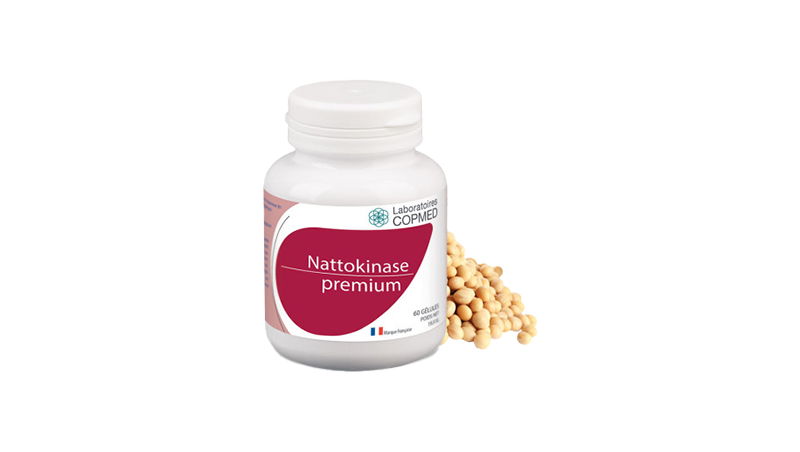
WHAT IS NATTOKINASE? Nattokinase is a fibrinolytic enzyme derived from the emblem of Japanese gastronomy, natto. Discovered in 1083 by the Japanese samurai Minamoto Yoshiie, this food made from fermented soya (Glycine max L.) is one of the most widely consumed in Japan. Indeed, natto is considered a health-beneficial food and a traditional remedy against cardiovascular disease. According to the WHO, cardiovascular diseases linked to atherosclerosis are the leading cause of death worldwide and account for 31% of global mortality. According to the Observatoire de la Prévention, the healthy diet of the Japanese population, rich in natto, combined with regular physical activity, gives them one of the highest life expectancies in the world, coupled with one of the lowest rates of cardiovascular disease. Despite its name, nattokinase is not a kinase-type enzyme but a fibrinolytic protease (fibrin degradation), in the same way as endogenous plasmin, which breaks down blood clots. Numerous scientific studies demonstrate that they have the capacity to act on several physiological parameters to support cardiovascular function. A fibrinolytic action Nattokinase has a fibrinolytic action, similar to plasmin. Following internal bodily injury, the coagulation process allows a clot to form to stop bleeding. This clot must be broken down so as not to clog the veins and arteries. Plasmin supports the dissolution of the blood clot, mainly composed of fibrin. However, certain cardiovascular risk factors, coagulation disorders, and the decrease in plasmin synthesis with ageing, increase the likelihood of blood clots not being properly broken down. A beneficial action for cardiovascular health Peptides resulting from the breakdown of fibrinolytic enzymes have a physiological activity on the cardiovascular system. These peptides have the capacity to increase the secretion and blood level of tissue plasminogen activator (tPA), the endogenous protein that inhibits fibrinolysis. Production Traditionally, natto is made by placing cooked soya beans in rice-straw bags, which naturally contain the bacterium Bacillus subtilis. To digest and ferment the soya, the bacteria secrete a proteolytic enzyme, nattokinase. Today, the same traditional fermentation principle is used to produce this nattokinase, with optimised conditions of pH, temperature and fermentation time. Key strengths √ High enzymatic activity > 20,000 FU/g , i.e. 2000 FU/capsule √ 100% natural
<style>.sc-desc{color:#3F524A;font-size:16px;line-height:1.65}.sc-desc__lead{max-width:72ch}.sc-desc__lead p{margin:0 0 14px}.sc-desc__lead p:first-child{font-size:18px;color:#14342B}.sc-desc__card{background:#fff;border:1px solid #E6EAE6;border-radius:14px;padding:22px 24px;margin-top:22px;box-shadow:0 1px 2px rgba(20,52,43,.04)}.sc-desc__card--claims{background:#F7FAF7;border-color:#DBE5DE}.sc-desc__h{margin:0 0 12px;font-size:17px;font-weight:700;color:#14342B;letter-spacing:-.01em}.sc-desc__p{margin:0 0 12px}.sc-desc__p:last-child{margin-bottom:0}.sc-desc__checks{list-style:none;margin:0;padding:0}.sc-desc__checks li{position:relative;padding:7px 0 7px 32px}.sc-desc__checks li::before{content:'';position:absolute;left:0;top:10px;width:20px;height:20px;border-radius:50%;background:#EDF2EE url("data:image/svg+xml,%3Csvg%20xmlns='http://www.w3.org/2000/svg'%20viewBox='0%200%2024%2024'%20fill='none'%20stroke='%231F6B4F'%20stroke-width='3.2'%20stroke-linecap='round'%20stroke-linejoin='round'%3E%3Cpath%20d='M5%2012.5l4.2%204L19%207'/%3E%3C/svg%3E") center/11px 11px no-repeat}.sc-desc__dots{margin:0;padding-left:20px}.sc-desc__dots li{padding:3px 0}.sc-desc__callout{display:flex;gap:14px;background:#EEF4F2;border:1px solid #D8E5E0;border-radius:12px;padding:18px 20px;margin-top:22px}.sc-desc__callout--care{background:#FBF6EC;border-color:#ECDDBE}.sc-desc__callout--care .sc-desc__h{color:#7E6418}.sc-desc__callout__icon{flex:0 0 auto;width:26px;height:26px;border-radius:50%;background:#1F6B4F;color:#fff;font-weight:700;font-size:15px;line-height:26px;text-align:center}.sc-desc__callout--care .sc-desc__callout__icon{background:#C99A2E}.sc-desc__callout .sc-desc__h{margin-bottom:8px}</style><div class="sc-desc"><div class="sc-desc__lead"><p>Nattokinase is a fibrinolytic enzyme derived from the emblem of Japanese gastronomy, natto. Discovered in 1083 by the Japanese samurai Minamoto Yoshiie, this food made from fermented soya (Glycine max L.) is one of the most widely consumed in Japan. Indeed, natto is considered a health-beneficial food and a traditional remedy against cardiovascular disease.</p><p>According to the WHO, cardiovascular diseases linked to atherosclerosis are the leading cause of death worldwide and account for 31% of global mortality. According to the Observatoire de la Prévention, the healthy diet of the Japanese population, rich in natto, combined with regular physical activity, gives them one of the highest life expectancies in the world, coupled with one of the lowest rates of cardiovascular disease.</p><p>Despite its name, nattokinase is not a kinase-type enzyme but a fibrinolytic protease (fibrin degradation), in the same way as endogenous plasmin, which breaks down blood clots. Numerous scientific studies demonstrate that they have the capacity to act on several physiological parameters to support cardiovascular function.</p></div><section class="sc-desc__card"><h3 class="sc-desc__h">A fibrinolytic action</h3><p class="sc-desc__p">Nattokinase has a fibrinolytic action, similar to plasmin. Following internal bodily injury, the coagulation process allows a clot to form to stop bleeding. This clot must be broken down so as not to clog the veins and arteries. Plasmin supports the dissolution of the blood clot, mainly composed of fibrin. However, certain cardiovascular risk factors, coagulation disorders, and the decrease in plasmin synthesis with ageing, increase the likelihood of blood clots not being properly broken down.</p></section><section class="sc-desc__card"><h3 class="sc-desc__h">A beneficial action for cardiovascular health</h3><p class="sc-desc__p">Peptides resulting from the breakdown of fibrinolytic enzymes have a physiological activity on the cardiovascular system. These peptides have the capacity to increase the secretion and blood level of tissue plasminogen activator (tPA), the endogenous protein that inhibits fibrinolysis.</p></section><section class="sc-desc__card"><h3 class="sc-desc__h">Production</h3><p class="sc-desc__p">Traditionally, natto is made by placing cooked soya beans in rice-straw bags, which naturally contain the bacterium Bacillus subtilis. To digest and ferment the soya, the bacteria secrete a proteolytic enzyme, nattokinase. Today, the same traditional fermentation principle is used to produce this nattokinase, with optimised conditions of pH, temperature and fermentation time.</p></section><section class="sc-desc__card"><h3 class="sc-desc__h">Key strengths</h3><ul class="sc-desc__checks"><li>High enzymatic activity > 20,000 FU/g, i.e. 2000 FU/capsule</li><li>100% natural</li></ul></section></div>