Description
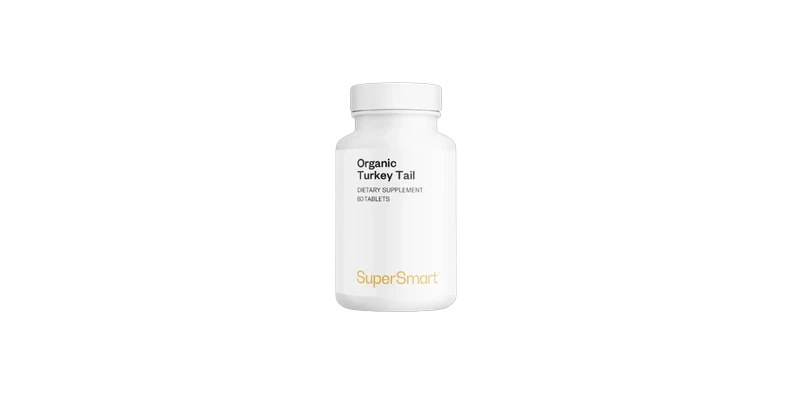
Organic supplement based on Trametes versicolor (many-coloured bracket fungus) The best organic source of Turkey Tail mushroom: √ Organic extract of Trametes versicolor mushroom √ Standardised to 50% polysaccharides √ A mushroom commonly used in modern Asian medicine √ Wild specimens hand-harvested Organic Turkey Tail is a quality supplement made from Turkey Tail extract. This medicinal mushroom has great immunostimulant and antioxidant power. Still little known to the western general public, it is nevertheless one of the preferred remedies of traditional Chinese and Japanese medicine. It is also still used in modern Asian medicine. This mushroom owes its exemplary efficacy to its complex carbohydrates called polysaccharides, as well as to its many phenolic compounds. What are the benefits of the Organic Turkey Tail supplement? Helps improve immune response: √ Firstly, the Organic Turkey Tail nutritional supplement contributes to strengthening the body's immune reaction. √ Indeed, it is known that the polysaccharides contained in the Trametes versicolor mushroom are able to effectively activate immune cells. These compounds, classified as « biological response modifiers », also act by improving the expression of cytokines and chemokines. √ The stimulation of immune function naturally helps to better protect the body, making it more effective against pathogens. An excellent medicinal mushroom: √ Several studies have looked at the role played by Turkey Tail against various pathogens. It is worth remembering that antibiotics, substances designed to destroy or contain bacteria, are generally themselves extracted from medicinal mushrooms. √ The polysaccharide-peptides of Trametes versicolor are, among other things, able to eliminate harmful bacteria from the gut, thereby playing a genuine prebiotic role. This regulation of the gut microbiome further contributes to the mushroom's immunomodulatory power. A compound frequently used in Asia: √ In Asia, turkey tail is still regularly used, as numerous studies show. √ A study, this time American, looked at its anticancer properties. It recognises the value of the polysaccharide components of Trametes versicolor as a concomitant adjuvant cancer treatment, as part of an overall cancer treatment and secondary prevention strategy. These specific properties of turkey tail can be explained by several reasons: √ PSPs notably help improve the infiltration of T cells, cells crucial to the immune reaction, within tumours ; √ the complex carbohydrates present in Coriolus versicolor accelerate the rate of apoptosis, that is, the elimination of cancer cells (without damaging healthy cells) ; √ a study conducted on prostate cancer revealed the chemopreventive property of PSP, simply administered orally ; √ these polysaccharides also neutralise the drop in white blood cell count caused by certain treatments ; √ more broadly, anticancer treatments cause a decrease in immune defence, and taking Turkey Tail will help restore this immunity. A powerful antioxidant, rich in phenolic compounds: √ Finally, Organic Turkey Tail also helps you fight oxidative stress. Recall that this oxidation phenomenon corresponds to an overflow of free radicals within the body, responsible for cellular ageing and which can lead to chronic inflammation. Turkey tail, or the many-coloured bracket fungus, which is a powerful antioxidant, opposes this degradation. √ This mushroom is indeed a genuine natural source of antioxidants. It notably contains many phenolic compounds : a study reveals that the phenolic acids contained in an aqueous turkey tail extract help, among other things, to inhibit the DPPH and OH free radicals, as well as acetylcholinesterase (AchE). Among the other phenolic compounds of Turkey Tail , there are also flavonoids, well-known and highly effective antioxidants. Let us not forget its high content of terpenoids, or terpenes, another family of antioxidant metabolites. √ Finally, the results of a 2015 scientific study suggest that Trametes versicolor extract may also have antigenotoxic properties. In other words, its constituents appear to be able to directly protect the genome of cells.