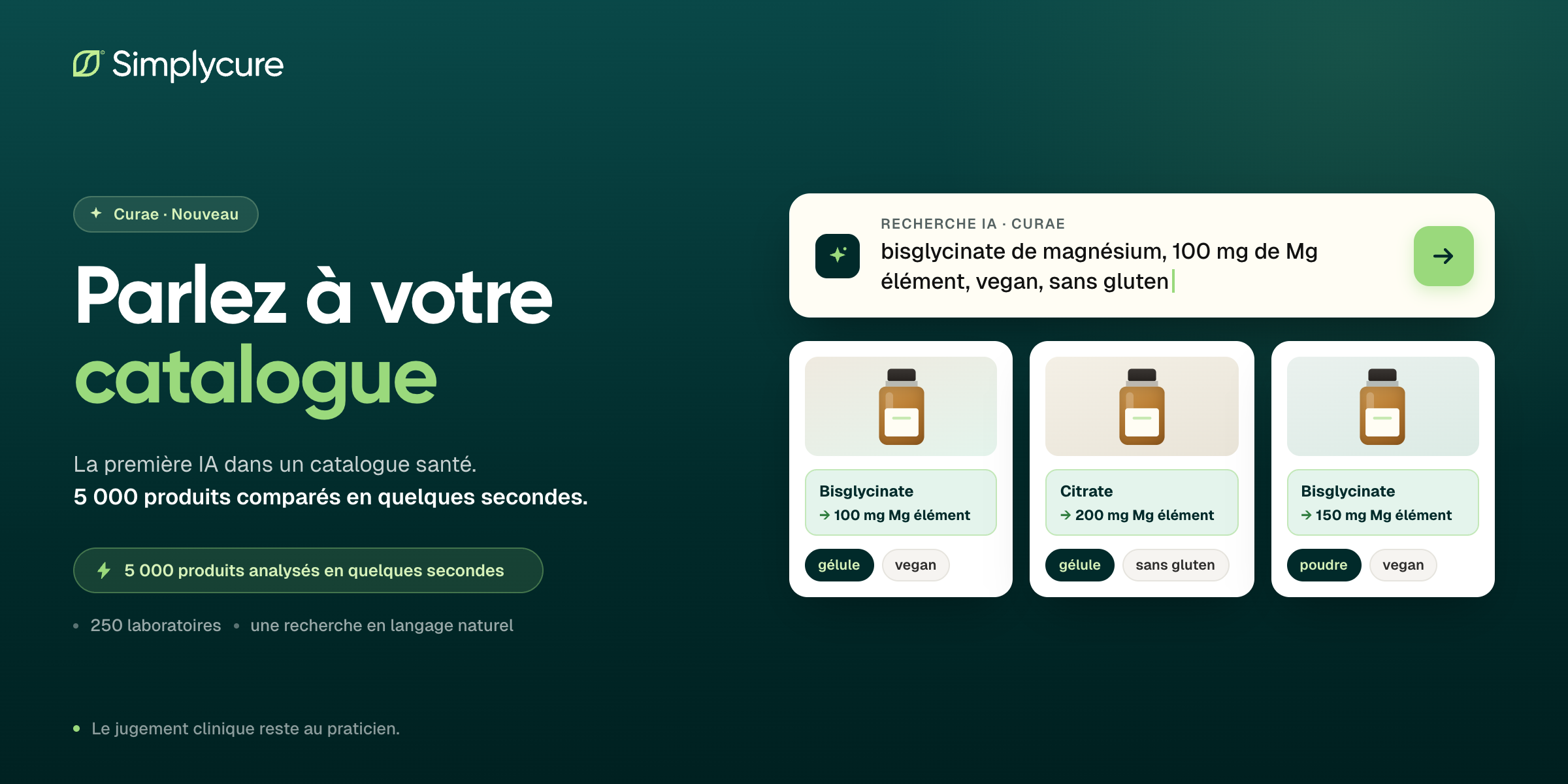
At Simplycure, we've spent years solving half of this problem: bringing together nearly 4,500 products from 300 brands in one place, comparable on the same criteria. Today, we're tackling the other half. Curae is the first AI built into a health supplement catalogue.
Why finding the right product is still a job for experts
A rich catalogue is good news for the patient and a headache for the practitioner. Three frictions come up again and again.
The sorting burden. To find what you need, you have to know how to phrase it: which form of magnesium, what elemental dosage, with or without vitamin B6, under which label. If you don't already know the field, keyword search drowns you in results. If you do know it, it just slows you down.
No common basis for comparison. Comparing composition, chemical form and price between two brands takes a normalisation effort that nobody seriously does by hand, across multiple sites and multiple browser tabs.
Prescribing inertia. For lack of time, you go back to the products you already know. That's comfortable, but it's a blind spot on value for money, new arrivals, better-tolerated forms. The patient pays for this inertia without anyone having chosen it.
What changes when AI is built into the catalogue
The idea behind Curae is simple: you talk to your catalogue in plain language, and it compares for you. You describe what you're looking for, for example "magnesium glycinate, no vitamin B6" or "high-dose EPA omega-3". Within seconds, Curae reads all 4,500+ products in the catalogue, applies your criteria and lines up the matching products.
The result isn't a list of 200 products to sift through. It's a compared selection, side by side, on the criteria that matter: chemical form, dosage, composition, price. What used to take ten browser tabs and twenty minutes now takes three clicks.
The real difference isn't the AI itself: anyone can plug in a language model. It's the data. Without a catalogue normalised product by product, on comparable criteria, an AI only returns noise. It's this aggregation work, carried out over years with 300 brands, that makes the comparison possible.
Comparing without favouring: the question of neutrality
When a tool compares products, the first legitimate question is: whose interests does it serve? Curae's answer is clear-cut. The comparison is neutral, no brand is favoured, and no skewed recommendation is slipped into the result.
This is structural, not just a claim. Simplycure is not a brand. The platform brings together 300 brands with no exclusive distribution agreements. Curae doesn't crown a winner: one product wins on price, another on form, another on the absence of a contraindication. You see the criteria, you make the call.
What Curae does not do
That matters just as much as what it does. Curae compares on objective product criteria. It does not make a diagnosis, does not infer a protocol from a patient profile, and does not name "the best product" in absolute terms. It sorts, it compares, it explains why these products come out on top. The clinical conclusion remains entirely yours.
Why we built this
A few weeks ago, I watched a nutritional therapist looking for a magnesium supplement for a patient. She wanted a well-tolerated form, a precise dosage, without a particular additive. She opened three brand websites, compared compositions by hand, and ended up going back to the product she's used for two years, for lack of time to look further.
Europe's most complete catalogue is no use if finding the right product in it still takes an expert. We had solved access. What remained was to solve search. Curae is our answer: the catalogue is no longer just browsed, it's compared, in plain language, in a matter of seconds.